
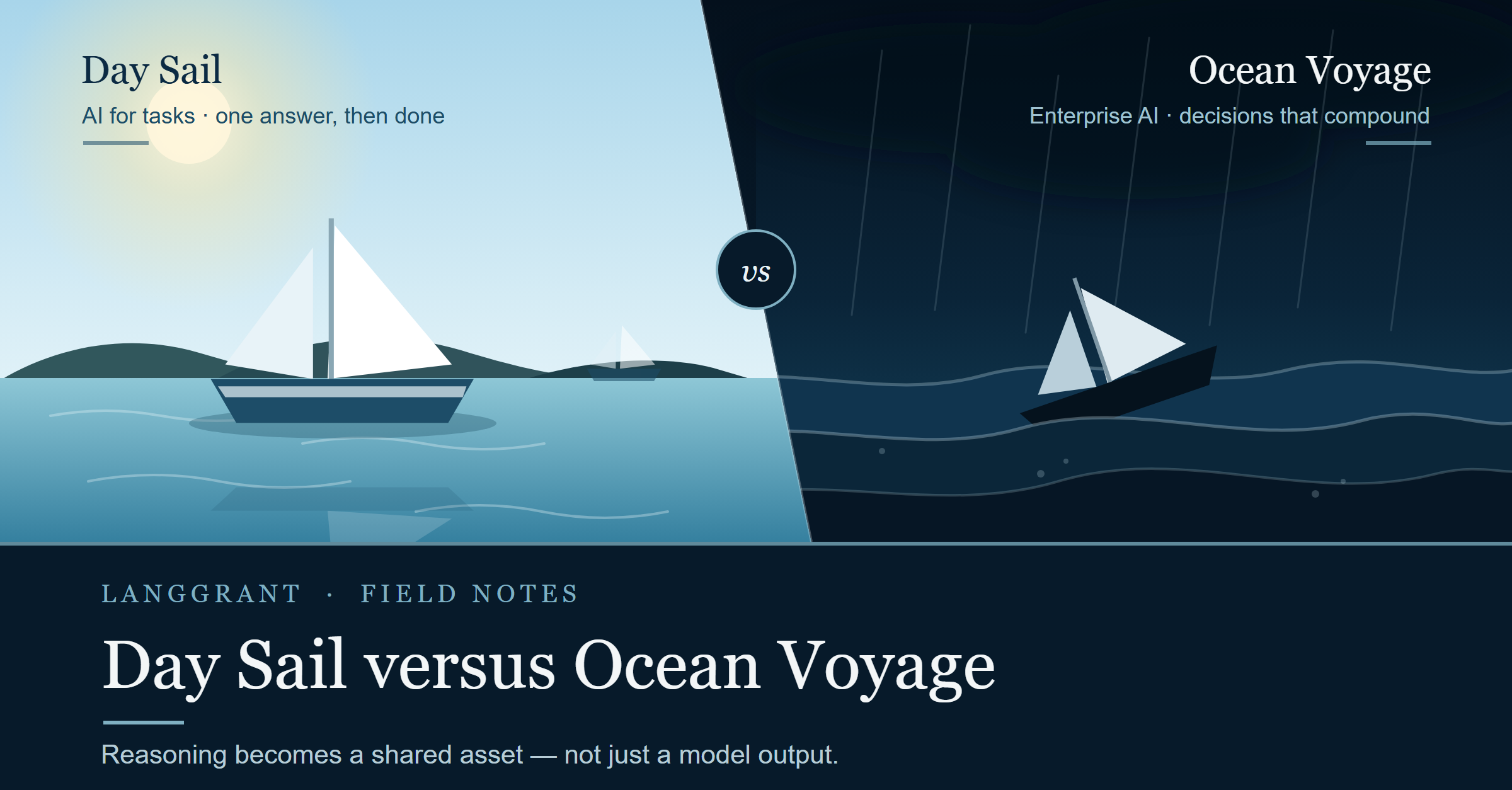
Inspired by whales surfacing near my boat last month in the San Juan Islands, I started writing a series of blogs comparing marine situations—changing forecasts, autopilots, and now offshore voyages—with corresponding analogies in the AI world.
With hurricane season starting for Atlantic sail crossings, this blog looks at another sailing contrast: day sails versus offshore voyages. And, of course, the comparison to AI usage.
Day Sail: AI Tasks
A relaxing afternoon sail in the San Juan Islands is relatively straightforward.
You rely on your boat and the natural safeguards around you: land, nearby boats, marinas, and the Coast Guard.
Relatively speaking, human judgment is useful but not critical during most of the journey. That is why you see many boats with mediocre skippers successfully complete day sails. The environment is forgiving—the destination is known, help is nearby, and most situations have simple recovery options.
The questions are mostly factual. You gather the context and get a go/no-go answer:
- Fuel enough?
- Fire extinguisher onboard?
- Weather forecast looks good?
- Does the engine start?
- Radio working?
- Bilge pump working?
Once these questions are answered, you make the decision and go.
Ocean Voyage: Enterprise AI
Crossing an ocean is a completely different exercise.
Equipment is likely to fail, and there are no safeguards around you like land, nearby boats, or the Coast Guard.
Human judgment becomes critical because the skipper is continuously making decisions in uncertain and changing conditions.
The context is different:
- The forecast will be wrong.
- Equipment will fail.
- The crew will become tired.
- New challenges will arise that were never planned for.
You cannot get a simple go/no-go answer.
The answer depends on many factors: Do you have enough people onboard with the right skills? Is the boat prepared? What tradeoffs should be made? Does the skipper have the judgment required for the conditions ahead?
The voyage is not one decision.
It is continuously making better decisions using the expertise of the people onboard and the changing condition of the boat.
AI Has the Same Distinction
Many AI use cases are like day sails.
Examples include:
- Writing an email.
- Summarizing a document.
- Explaining a spreadsheet.
- Generating SQL.
- Producing a report.
The context is the email outline, spreadsheet, document, or prompt.
The model delivers an answer.
The task is complete.
Enterprise AI Is Different
Running an organization is not a one-time question.
The context keeps changing:
- Pricing changes.
- Customers change.
- Competitors change.
- Regulations change.
- Supply chains change.
- Data changes.
AI cannot navigate these challenges by simply delivering an answer.
An offshore skipper does not throw away yesterday’s navigation log every morning.
Today’s decisions depend on yesterday’s experience and human judgment. The voyage continuously adapts based on what has been learned.
Yet that is how many AI systems operate today.
Every prompt begins from scratch, perhaps with some previous chat history. Much of yesterday’s reasoning disappears.
The contrast is between a day sail that gets an answer today and an offshore voyage that focuses on good decision-making over the long term.
One strategy focuses on producing the best possible answer today.
The other focuses on improving decisions continuously.
The first optimizes for tasks.
The second optimizes for journeys.
If AI is solving isolated tasks, the model can own most of the reasoning.
If AI is helping organizations navigate an ongoing journey, the enterprise must continuously contribute its own judgment, experience, policies, and objectives.
Reasoning becomes a shared asset—not just a model output.