
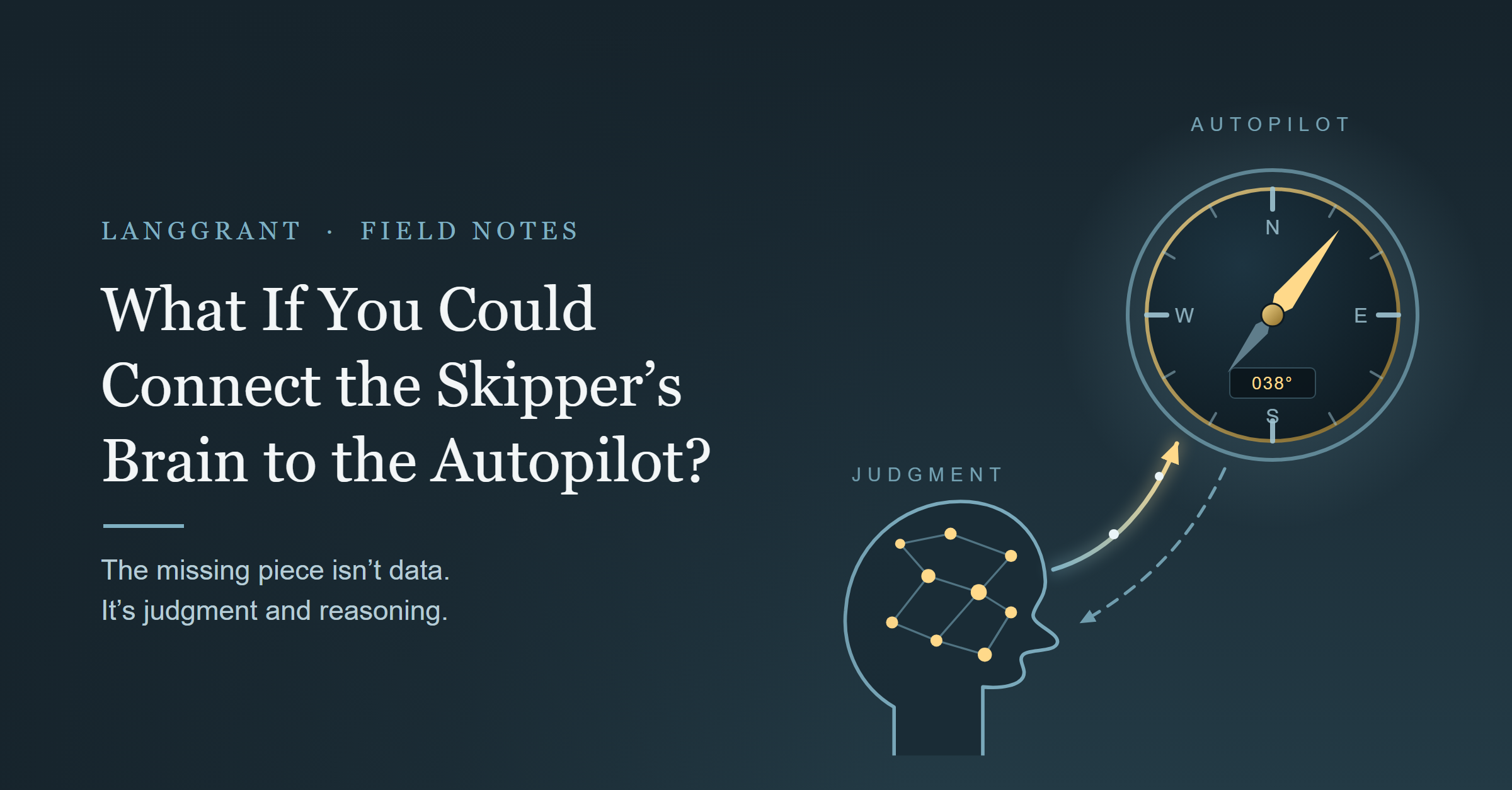
In the last article, I asked: Who should be at the helm—the enterprise or the autopilot?
But perhaps that is the wrong question.
What if the answer isn’t choosing between the skipper and the autopilot?
What if you could connect the skipper’s brain to the autopilot?
A modern autopilot is an incredible tool. It knows the heading, wind direction, speed, and can make constant course corrections to keep the boat moving efficiently.
But the autopilot doesn’t know:
- Why the skipper chose this route.
- Why she avoided that channel.
- What experience taught her about this weather pattern.
- Which tradeoffs matter most.
The missing piece is not data.
It’s judgment and reasoning.
The same challenge exists with AI.
Today’s AI models are incredibly capable. They can:
- Generate solutions.
- Write code.
- Analyze information.
- Reason through complex problems.
But they don’t naturally contain:
- Your organization’s decision history.
- Your experts’ judgment.
- Your business rules.
- Your accepted ways of solving problems.
Context engineering emerged as an attempt to package these inputs and make them available to models.
But providing context is different from transferring ownership of reasoning.
Much of the current AI trajectory is moving toward a future where models own more of the reasoning loop, and enterprises adapt their workflows around increasingly autonomous systems. Loop Engineering, model routing, and other emerging approaches enable this direction.
An alternative approach is that the enterprise owns the reasoning, and the model amplifies it.
This is a largely unexplored area, but Satya Nadella’s Learning Loop is an early expression of this idea—where humans, AI models, and deterministic software systems work together iteratively to increase organizational intelligence.
This approach is like connecting the skipper’s brain to the autopilot.
The goal is not to replace the skipper or eliminate the autopilot.
The goal is to create a shared reasoning system.
Imagine if the skipper could instantly understand why the autopilot changed course—and the autopilot could understand why she made a decision. The boat would not have a human operator and a machine operator. It would have a team that combines human judgment, machine capability, and continuous learning.
The next generation of AI won’t just be about making models more intelligent.
It will be about enabling organizations to create, preserve, and continuously improve reasoning that is shared by models, people, and systems.
The future may not belong to the best autopilot.
It may belong to the best connection between the skipper and the autopilot.